My Internship @ CoreWeave

I am very excited to announce that I have received an internship at CoreWeave, a company at the bleeding edge of the data center industry, as one of its first high school interns. I will be working on the CoreWeave capacity team, where I will learn the skills of an industrial engineer and how that field applies to the rapidly growing data center industry. In this post I will cover what CoreWeave is and give a brief overview of what I will be doing there.
For those who don't know what CoreWeave is: founded in 2017, it is a publicly traded cloud computing company that builds and sells computing capacity in high-density data centers tailored to AI training. CoreWeave sets itself apart from more traditional cloud providers like AWS by being an "AI Hyperscaler," and through its partnership with NVIDIA (the manufacturer of CoreWeave's GPUs) to deploy their latest early-release chips at scale. Both of these take enormous amounts of planning, communication, and forecasting to pull off. As of Q1 2026, CoreWeave has about 1 GW of active power, but it has committed to "expanding its planned contracted data center capacity by 2030 with an additional 5GW" (Butler). In the AI world, power consumption pretty much equates to training ability, and therefore profit. A capacity increase this large will inevitably create problems different from the ones the company faces today.
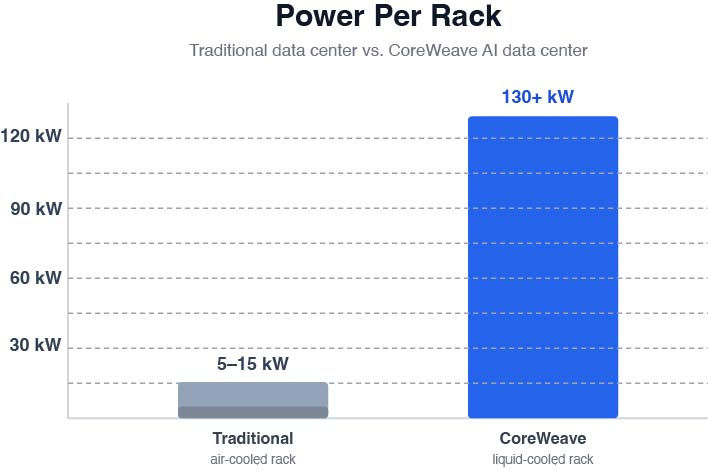
For example, as power consumption grows this much, power itself becomes the limiting resource. While in traditional data centers, the major bottleneck may be floor space, the density of CoreWeave's racks make the power a much more important concern. To put that density in perspective, a rack in a traditional data center draws somewhere between 5 and 15 kilowatts, while CoreWeave designs its racks for 130 kilowatts or more, roughly ten to twenty times the power packed into the same floor space.
The bottleneck migrates off the data center floor and onto the capacity of the electrical grid, forcing CoreWeave to account for it through site location, construction of new electrical infrastructure, and long-range planning. Small forecasting errors also compound at this scale. On top of that, CoreWeave contracts out its capacity before the infrastructure is even built. This removes some of the market's instability, but it changes the company's dynamic: if a data center goes offline, CoreWeave isn't just missing potential profit, it is breaching a contract with a customer, which damages the relationship and costs money. In an industry where traditional data centers waste an estimated 20 to 40% of their capacity to stranding, meaning resources that are installed but not available for use (Nordcad), the need for IE skills is greater than at most traditional companies.
This brings me to my role at the company. I am working on optimizing the augmentation of data centers, specifically the process between a client requesting an augmentation and that augmentation actually beginning. An augmentation in the context of CoreWeave data centers is defined as the addition or altering of racks at the data center in order to increase capacity to meet specific clients' needs. At first glance this doesn't look like a classic IE project, since no physical product is being built at any step. But it is exactly the kind of work industrial engineering covers: an administrative process with real bottlenecks and delays that can be mapped and improved. Over the six weeks of my internship, I will build a process map of that workflow and propose a solution to make it more efficient. Throughout my internship, I will bring you along on my journey and share everything that I learn!
Works Cited
Attias, Michelle. “Preventing Wasted Capacity in Data Centers In 2026.” Nordcad, 27 Oct. 2025, https://www.nordcad.eu/stranded-capacity-in-data-centers/. Accessed 16 July 2026.
Butler, Georgia. “CoreWeave Aims to Add 5GW More Data Center Capacity by 2030, Anticipates Capex in 2026 to Double.” DataCenter Dynamics, 3 Mar. 2026, https://www.datacenterdynamics.com/en/news/coreweave-aims-to-add-5gw-more-data-center-capacity-by-2030-anticipates-capex-in-2026-to-double/. Accessed 20 July 2026.
CoreWeave, Inc. “CoreWeave Reports First Quarter 2026 Earnings.” U.S. Securities and Exchange Commission, SEC, Feb. 2026, https://www.sec.gov/Archives/edgar/data/1769628/000176962826000220/coreweave1q26earningspress.htm. Accessed 20 July 2026.
Very interesting material
Hello!
What kind of bottlenecks and delays will you be working to improve?
Uncle Bruce